The Property of Property
Added 2023-10-25 17:28:15 +0000 UTCOn Possession, Property, and Haunting; on Colonialism, Alienation, and Commodity Fetishism
Part 3 of a Gothic Marxist Consideration of Horror as Capitalist Cultural Production
Possession is one of the key concepts in modern Horror, though Horror shares it with other genres.
The genre of Horror is generally much less concerned with examining the technical functioning and ramifications of the concepts it plays with than is SF, or even Fantasy. Horror, for all its faults, has the great virtue of being content (or being able to be content) with the unexplained and the numinous, the irrational, and the logic of association. SF and Fantasy trade in such things too, but are always troubled by it. They always worry, as it were, about how the inexplicable works, or at least about their own failure to explain. To draw from some theorising about SF and Fantasy, SF needs to have an implied authority figure somewhere in or behind the text who understands the ‘scientific’ principles, as it were, ‘for’ the reader. Horror, based far more directly on unfiltered human psychological unease, is much more content to allow association to stand for explanation. Indeed, Horror will often use the proximity of certain shapes or representations as explanation enough for plot developments, something SF/Fantasy is far more leery of doing. Thus, when SF/Fantasy gets hold of the concept of possession, it tries to parse it in ways that Horror doesn’t bother with. Beyond technobabble explanations, SF tries to separate out and rationalise the various modes or forms of the concept of possession, to categorize them. Thus, the instinctive desire on the part of a SF story dealing in Horror ideas, to confront them, interrogate them, and tease them apart from ostensibly material concepts with which they tessellate; categorise everything in pseudo-scientific terms, marginalise and ghettoise the ‘supernatural’ versions of concepts which can be made material. In the process, SF which deals in its own version of possession manages to essentially destroy the power of the concept. It does so by literalising its relation to legal possession, and thus negating its implicit metaphorical import. When material possession is directly counterpoised to supernatural possession, the ability of supernatural possession to ‘stand for’ material possession is undermined. This implication is thus yanked out of supernatural possession. The entire Horror concept of possession is de-gutted. The moment you literalise an association, you destroy its power.
In modern Horror, possession is not only a recurring motif, it is also essential to the power of the genre, precisely because it allows the genre to get at the fundamental horror that is private property in a bourgeois society.
We’ve glanced (back in Part 1 of this series) at how the unease and anxiety of childhood informs the terrors of the ghost and horror genres. We glanced (in Part 2) at how the same genres express and adapt bourgeois ideological discourses about women. In this Part we’re going to take a look at how the concept of possession helps us link things up a bit.
Let’s make an obvious observation that seems a little too obvious to dwell upon, and which consequently tends to get overlooked… the observation that the word ‘possession’ refers to the concept of ownership. It is, at least in capitalist society, freighted with the idea of property. The moment we consider this, the relevance to the genres we’re talking about starts to become obvious.
Possession thus links in with the wider genre in terms of its interest in the issue of property. American ghost stories are almost always about property rights and land claims. They tend to begin, especially in cinema, with a family (white) moving into a new house. The house will be haunted by the prior property claims of people who used to live there, or who used to live on the land where the house is built. And it’s no mystery why, really.
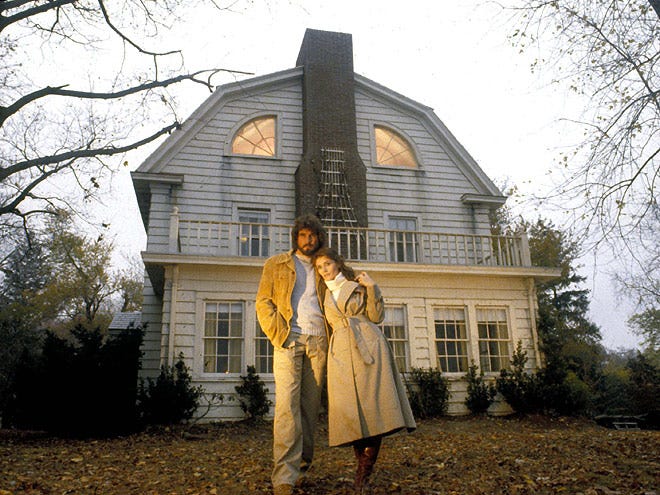
The Amityville Horror, the archetypal ghost story of this kind since the ‘70s, is about a white family, the George and Kathy Lutz and kids (doesn’t get much whiter than ‘Lutz’ really does it?), moving into a new house. Ostensibly, the house is haunted by demons, or possibly by the ghosts of the Defeo family (the previous residents, murdered there by the eldest son), or possibly by a devil-worshipping former occupant, or possibly by the denizens of an ancient ‘Indian burial ground’ upon which the house was built, or possibly by marching bands and floating pigs (the book doesn’t trouble itself with clarity on this issue). The supposed end result is that the family are driven out of the house, and the bank reclaims it. In actual fact, the story seems to be about a small businessman taking on a financial burden he can’t manage while also trying to handle the stresses of a reconstituted family, having some personal and business problems as a result, possibly imagining some stuff, realising he might be able to make some money from living in a house where some murders happened, and concocting a story in cahoots with the Defeo murderer’s lawyer, and then later with a novelist. (The real Ed and Lorraine Warren colluded in talking up Amityville into a media phenomenon, going to the house and performing their standard histrionics… an event worked into the second Conjuring movie.) But, putting reality firmly to one side, the story we get is of a house that rejects a family because of an array of former claims.
Key to The Amityville Horror is the concept of the house being built on an ‘Indian burial ground’. A detail that is almost too telling. Really doesn’t require much parsing, does it? The detail is so telling it’s almost immediately self-ridiculing. It’s one of those things that becomes a cliché immediately, even before it is actually widely used. It is, of course, an adaption of older discourses of Horror. The vengeful return of those ‘we know ‘we’ have wronged; their irrational, inscrutable, extravagant and fanatical vengeance being so over-the-top that it invalidates their claims to justice. It can be traced through stories of the uncanny in many imperial cultures. In the British Empire, an entire uncanny literature developed in which the British were menaced by the spectral or monstrous return of the imperially repressed. Mummies arise in Egyptian tombs to avenge themselves upon British imperialism, thus backhandedly validating the imperialism they ostensibly critique.
American ghost/Horror stories of this type since Amityville have tended to be aware of the cliché and to address or subvert it in some way.
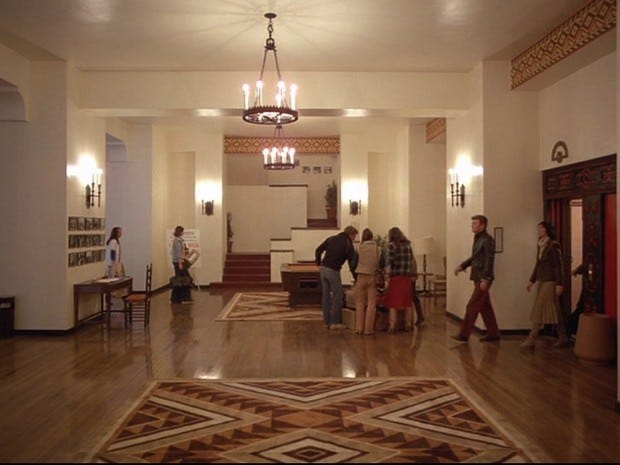
Kubrick’s The Shining takes the story of the ‘Indian burial ground’ and inverts it with ruthless cunning. The notion that the Overlook Hotel is built on appropriated Indian ‘burial ground’ is mentioned in a throwaway and flippant manner early in the film. The vanished (i.e. ethnically cleansed and/or exterminated) Indians do haunt the hotel. But it is not their presence which haunts but their absence. There are ‘Cherokee designs’ all over the place, representations of Indians, etc, but no Indian ghosts. (I know I’m drawing on what is represented in the documentary Room 237 as a crackpot ‘theory’ about The Shining, but I happen to think the observation has a lot of resonance, even if I don’t agree with some of the larger claims made by its proponent.) Rather, the hotel is haunted by the culture that drove the Indians off and built a palace of wealth and decadence on their land. The hotel is haunted not by the anger of those with the original claim but by the horror of those who usurped it, by their subsequent history and society.
Similarly, in Tobe Hooper’s Poltergeist, the idea of the suburban development being built on “ancient tribal burial grounds” is mocked. Rather, the haunted house is built on the graves of “just people” (i.e. white people), who were left under the house by the money-grubbing developers, thinking they’d get away with it if they “only moved the headstones.”
Subversions aside, the stories are still inescapably about property rights and land claims, about the anxiety of American capitalist imperialism precisely because it starts as settler colonialism. The structures (metaphorical and literal) of the society are seen as unstable, undermined, unsafe, because they are (metaphorically and literally) constructed on top of somebody else’s land. The houses are haunted by the prior claims, or by the knowledge of the prior claims, or by the facts of the usurpation. Even if the literal aboriginal inhabitants are erased or effaced from the narrative, the idea of the haunting being based on prior property claims to real estate lingers. It is a foundational assumption.
The Conjuring movies, true to their open project of resurrecting the styles and motifs of the Horror cinema of the past (because of their emanation from a dated but still resonant generation of scares), consciously fit themselves into this tradition. In the first film, the (white) family moves into a new home, which turns out to be still haunted by the spirit of the witch Bathsheba, who considers anyone who moves onto ‘her land’ fair game. She wreaks havoc on such intruders, whether they’re in ‘her’ house or living in adjoining properties that used to be part of ‘her’ estate. And she does this by possessing the womenfolk of the intruding families and causing them to kill their own children.
The second film is set in England, and so presents a problem for the film makers, as English ghost stories are not usually about property rights in the same way. They are very much concerned with such things, but the inflection is different, for the obvious reason that Britain was a settler colonial state (i.e. post-conquest Norman Britain) much longer ago than America. (We might talk about British/English ghost stories and Horror some other time.) Conjuring 2 adapts an aspect of the supposed ‘real’ case of the ‘Enfield Haunting’, which is that the little girl at the centre of it apparently claimed to be possessed by a man who had lived and died in the house before her family moved in. She liked to say things like “Get out!” and “This is my house!” in a silly deep voice which ‘paranormal researchers’ found impressive for some reason. The house in question would’ve been a council house, so there’s no question of actual property rights, but nevertheless, the issue is still a proprietary one, and one of propriety (linked concepts, of course). Bill Wilkins, the old gentleman in question (who could never have dreamt that one day he’d be a villain in a Hollywood movie) is supposed to be angry about strangers in his home. It is ‘his’ home in the sense that he considers himself the proper tenant. It’s wrong for there to be all these kids and their single mum hanging around, changing the channel when he’s trying to watch the snooker on TV, etc.
The little girl in the movie is, at least part of the time, possessed by the ghost of Wilkins. Similarly, in the first movie, the central and ultimate threat is the possession of the mother of the family. This, once again, places the Conjuring movies self-consciously in a tradition of American ghost/Horror tales. As with other aspects of the productions, the concentration upon bodily possession harks back to the seminal supernatural Horror movies of the ‘70s and early ‘80s, the ones that stand outside the more underground genres which concentrate on gore and often eschew the supernatural, religiose and/or spectral in favour of murder, mutilation and humans-as-meat, i.e. The Texas Chainsaw Massacre.
There’s Rosemary’s Baby and The Omen, both about children possessed by demonic entities or natures. Little Damien in The Omen is described by one character as “a human personality entire in his [the Devil’s] possession”.
But the big one is, of course, William Friedkin’s movie of The Exorcist, in which a little girl, squabbled over by her separated parents, living in a new home (it’s a temporary house in Washington while her actress mother films a right-wing movie there), finds herself taken over and inhabited by a demon. The quintessential horror movie/craze of the ‘70s, this film shows – once again – the horror that seems to emerge from within the private, atomised, unstable bourgeois family system itself, etc. But we’re talking here specifically about possession, not so much for what it means in these individual movies, but for what it connotes as a supernatural category, and how it connects to other basic and structural concerns of the genre.
Bodily possession by the uncanny is an expression of the convergence of complexes of historic and present anxieties about the atomised self and about property. Fundamentally it is the recognition of the horror that, under capitalism, the human body – and thus the human self – is treated very much the same way capitalism treats everything else: land, material, resources, etc. Like these things, the body is accumulated and turned into property (literally in the case of modern slavery) or treated very much as if it were property. The central occult secret of capital is how it accumulates. It does it by conversion of other things into itself. It does this brutally, through theft. It also does it more subtly, more mundanely, through the very process of production. Capitalism hides the production of value – which is done by the labour which transforms resources into commodities – behind myriad walls, literal and ideological. But that labour power – the ability to create value – is what capital appropriates from the worker. The worker is forced to sell their capacity to labour. Thus labour itself becomes a commodity. But it is the commodity which increases value. This is how profit accumulates. The ones who control the resultant commodities may pocket the value that is thus generated (or rather the surplus value, because some must be paid back, in the form of wages, to keep the worker alive and showing up in the morning). This is also how the labour of the worker is objectified and reified into commodities. The commodities are then appropriated by capital, and thus themselves are capital. Some of the products of labour become part of the capitalist-controlled process of exploitation. Labour literally creates the very force which parasitizes it. Labour, alienated from the worker, confronts the work as capital, as a hostile force.
Not only is the body ‘possessed’ by capital – either in the slave who is directly owned or in the worker who is economically coerced by the fact that they have no means to make a living other than working for another – but, also, the labour that is done by the body, and that value which the labour produces, is appropriated by capital. The process turns the body into a machine for producing that which dominates it. It turns the human body, and thus human life and the human self, into a toy, a doll, a puppet, a ventriloquist’s dummy. This puppet forges its own strings. It teaches its own handler how to make it twitch and walk. It folds itself back into the box after the show. Its own thrown voice tells its master what to make it say. This is the property relationship as applied to humans, be it open or hidden, grotesquely legally codified or dressed up at the liberty to be employed. It is immensely suggestive to me that modern horror concentrates so repeatedly on dolls, toys, playthings, dummies, usually in human shape. The human image alienated, objectified, reified, and rendered as a manipulable, helpless plaything… which also comes to get us. And let’s not forget that toys are manufactured things, commodities, sold for a profit. When they come to life we are witnessing the arising of “dead labour” which confronts the worker in capitalism as a “hostile and alien” power, to quote Marx. The image of the toy that attacks is a direct expression of commodity fetishism.
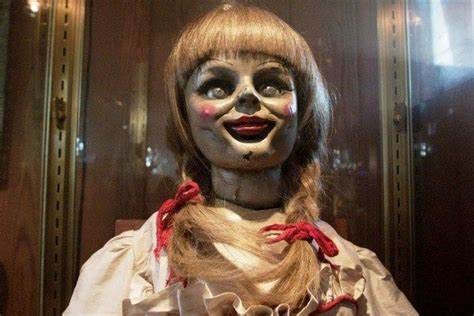
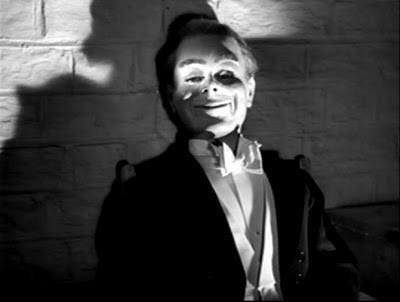
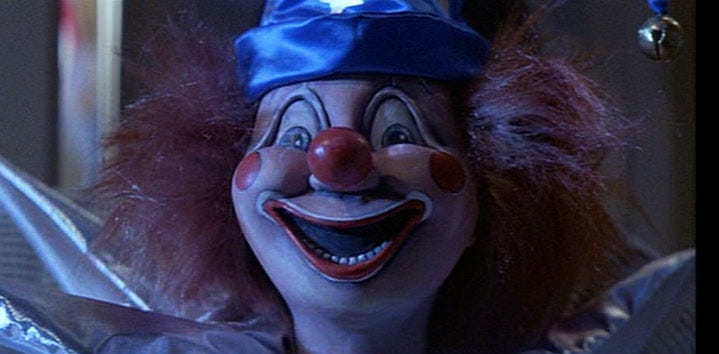
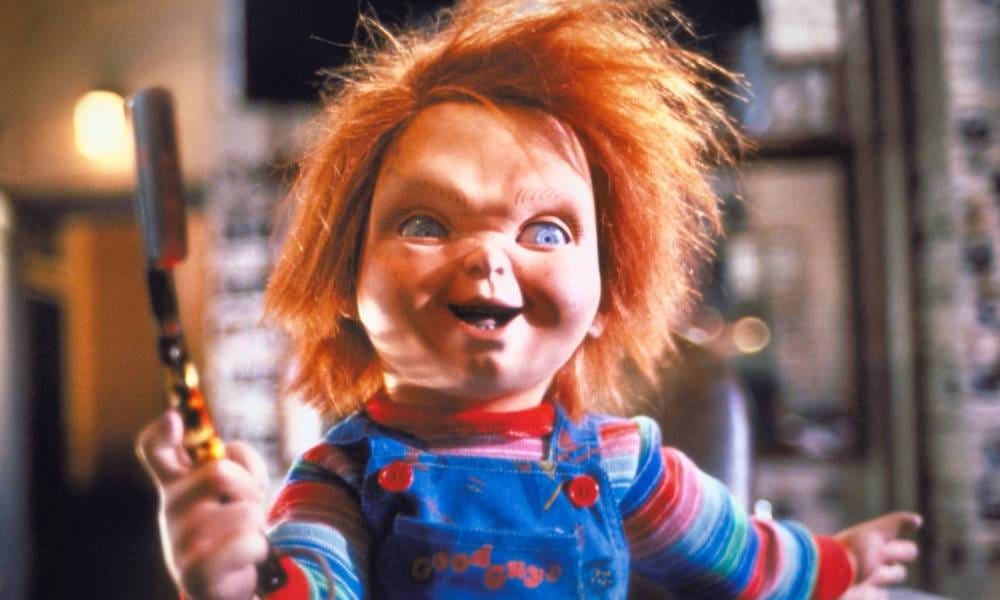
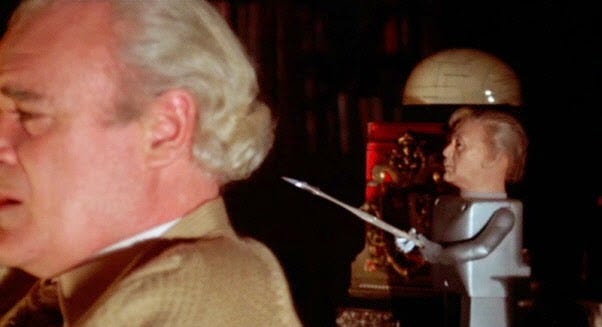
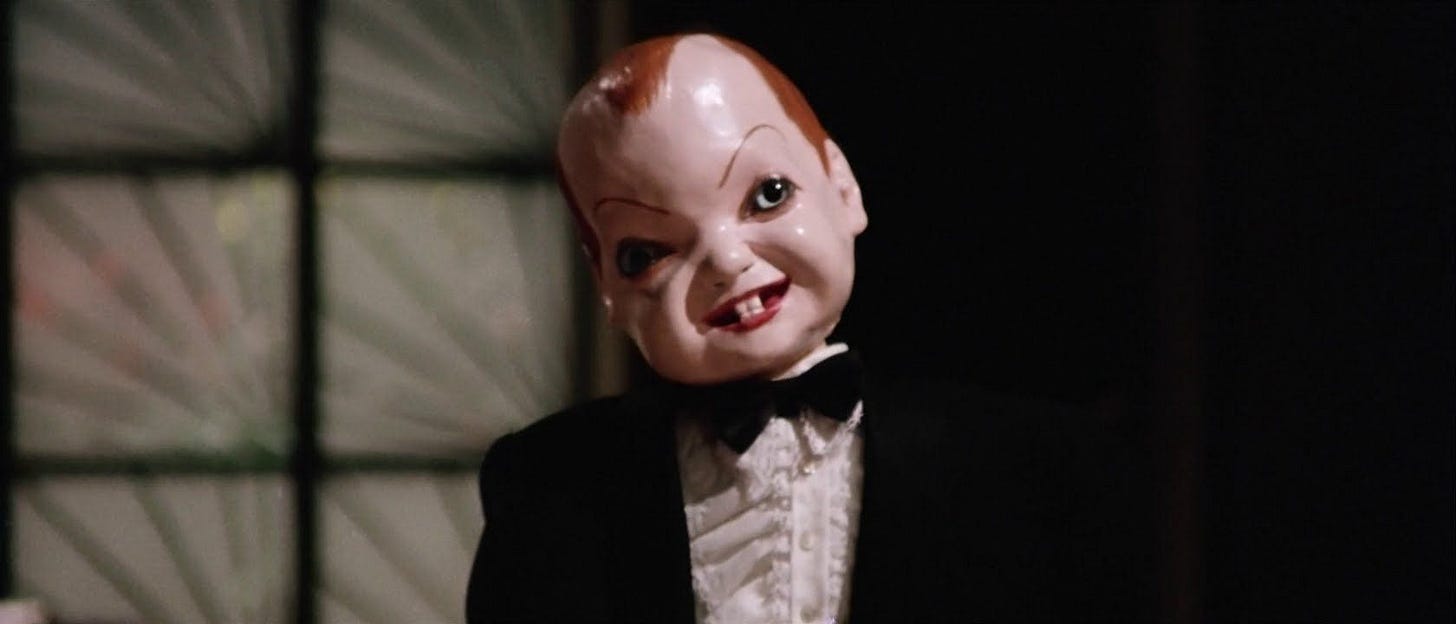
In the scenario of supernatural possession, the human body becomes a kind of human-shaped toy which is then played with by an inhuman force. The voice of the possessed becomes the voice of the demonic ventriloquist. The movements of the possessed are the movements of the demonic puppetmaster, twitching the strings. Possession, like haunted toys, is the supernatural expression of the expropriation of the body and bodily autonomy which is inflicted upon most of the human race, to a greater or lesser extent, every day in the capitalist system.
Concepts like ‘property’ and ‘ownership’ are just legal expressions of social relations of power and control. When someone ‘owns’ something, we just mean that our society has chosen to accept that they can do with it what they please. The effect of this is to make the thing that is owned, essentially, a part of the person (or organisation) which owns it. Capitalism confuses and meshes the body, the self, the will, and objects, all the time. This is never truer than with capital itself, which is a kind of group-mind, which appropriates everything, which converts things into itself, which uses that which it appropriates and converts as the material basis for further domination, further appropriation, further conversion. This is why, for instance, Axos and the Borg are capital. It is also the reason for these legions of phantoms and spectres and demons and invading spirits which haunt the capitalist culture industries and capitalist narratives.
There is no need to explain why this seemingly rather generalized syndrome applies specifically to these types of ghost/Horror stories. The uncanny genres are absolutely bound up with expressing the anxieties that teem and breed in the social wounds of modernity. They fill with these anxieties because that’s what they’re for: containing the expression of them. And these anxieties, conscious or unconscious, are keyed into the central and dominating horrors and terrors of life in modernity: the loss of bodily and temporal autonomy; the separation of society into atomised groups; the alienation of humans from the work that makes them human, and its products; the hovering of unaccountable and inexplicable forces over people lives, from the state to the workings of history itself, with all its sudden irruptions… and what could pertain more to our constant, every day, quotidian anxieties than the nagging sense that our lives are not our own, that our bodies are subject to whim and perils and dictats from forces alien to us? Simultaneously, what could be more bizarre? It’s by that constant awareness of the unfreedom that breeds inside what we call freedom, the irrationality of rational life, the seemingly inescapable juxtaposition of the bizarre and the quotidian, that the uncanny genre is informed and inspired.
But there’s another connection here, a specific one, which not only links this essay up with the previous two in this series, but which actually retroactively sheds some light on an aspect of all these connections that might’ve seemed obscure.
To digress again, just a bit…
I’ve already mentioned The Amityville Horror (which became a movie) and The Shining. The Shining is unusual in that the possession is more a matter of sympathy and seduction rather than the usurpation of bodily autonomy to a controlling force. Something similar occurs in The Amityville Horror, in which the man of the house is gradually seduced by the evil force within it. Like Jack Nicholson in The Shining, this character – George Lutz – is not taken over so much as enticed and suborned. The thing these two quasi-possessions have in common when compared to the others is obvious. They concern adult men. To put it crudely: men are not possessed in the same way because they are not property in the same way.
Remember that Rosemary’s Baby deals not only with a baby possessed by Satan or a satanic nature, but also with the treatment of a wife as property, pimped to Lucifer as part of a deal for success and wealth.
The nuclear family is, essentially, an invention of capitalism. It is the unit that allows the simultaneous atomisation and collectivisation to which capitalism and the industrial city subjects the workers. It is the form that allows the cost-free (to capitalism) reproduction of the workforce through unpaid female domestic labour. Capitalism adapts the patriarchy of feudalism to its own purposes, much as it adapts the feudal state, etc. Capitalism clears work out of individual homes and subjects it to the discipline of the workplace, freeing the home up to be a site of domestic labour purely for the reproduction of the lives of wage workers and future wage workers. In the classic and original form of the bourgeois family, the woman and the child are essentially property of the male worker. Even as he is exploited by the capitalist system at his workplace, so she is exploited both by him and, through him, the system that exploits him. Women and children are, to paraphrase John Lennon, the slaves of the slave.
This is why, or at least one of the reasons why, the usual subject of possession in the genre is a woman or a child. The ghost/Horror genre literalises the idea of the bodily and spiritual enslaving of women and children within the bourgeois family. It repeatedly returns to the idea of women and children as possessed. This can be subject to many thematic permutations. It can be portrayed as tragedy or as attack, or both. Both the threat to, and the threat of, the woman and child can be played up. Often both happen at once, it being one of the most powerful aspects of the idea of possessed women or children that they can be portrayed as both pathetic and sinister, both passive and on the attack, both owned and threatening the whole idea of property, all at once. The possession of the wife or child is the basis of the patriarchal bourgeois family, but is also a threat to the bourgeois family because ownership is always insecure, dependant upon the competitive market. The institution hands power to the man, yet the instability of the institution threatens the man, and thus the patriarchal mode in this part of the system. Within the system of representations, the idea of bodily possession is threatening in two contradictory but simultaneous ways: it presents the entire idea of ownership of women and children as sinister (thus problematising the entire family institution as it exists), but also threatens power of the particular male by undermining his personal ownership. It questions property rights over humans while also terrifying male power with the idea of losing those rights to some other force. The classic position of the male worker in the bourgeois family is thus perfectly addressed: he is both the owner of others within the home and threatened by a more powerful owner from outside, one who might take everything he ‘has’. He can own, subject to a hostile takeover from some more powerful owner whose claims he cannot stave off.
We see here a connection with the issue of land claims and house buying. The connection is the anxiety of relative position within hierarchy. The families in these stories are usually relatively privileged. As noted, they’re pretty much white by definition. As noted, George Lutz was a small businessman. (The families in the Conjuring movies are actually pretty unusual in that they are both explicitly working class and poor.) But the point is that insecurity runs through these families and their situations. They tend to be scared of financial disaster, debt, being unable to make mortgage payments or rent payments, losing their income, etc. Even the movie actress in The Exorcist finds herself having to back out of jobs, and thus endangering her income and career. There is always the threat to the home, the family, the domestic safety that is supposed to be our greatest comfort, our consolation and fulfilment in our otherwise work-filled lives. The home is as at risk of being taken away by hostile forces as is the body. The Leslie Nielsen Exorcist-spoof Repossessed actually achieves a very pertinent point in its title.
But the precarious position is relative, as noted. There is always the lurking awareness that even precarity is based upon someone else’s historic expropriation. In British ghost/Horror stories is tends to be the expropriation of the feudal. In American ones it’s the expropriation of those lower in the racial hierarchy, those upon whose destruction and/or enslavement the world of white nuclear families in nice houses is founded. Such families are thus haunted from above and below.
Possession, in this context, is not only the return of the repressed, it is also the puppeteering of the oppressor.
Comments
Jack! Read that stuff into a microphone and post it to the feed!
Jay P Hailey
2023-10-27 07:58:34 +0000 UTC