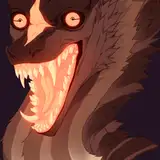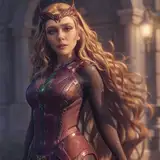
The lore:
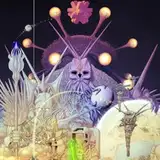
Beyond the north wind lies the fair haven of Upergora. At the heart of this blessed shire, however, lies a fell and grim lair: the Hourglass Stairwell, it is called. This Stairwell was burrowed through the earth by Dhegoma, Swoma, and their children, the Dwalves, with the aim of bridging the inner world of Concavia to the emptiness without, where the dark lord Tàmhas was cast at the end of the Days of Gold.
Long ago, in the Days of Silver, the Warding Mark was cast on the nether mouth of the Stairwell by the gyden Mehter to shut out her children, Swoma and Dhegoma, who had forsook her, outside the world to be with their dark lord, Tàmhas. Mehter then bade her throng of Albes to strive to shut the upper mouth of the Hourglass Stairwell. The throng of Albes hefted the great peak named Merucca from its roots and shut the Stairwell by standing the berg on its head. Mehter then bade her other children’s children, the Alves, to stand watch over the Stairwell and to see that the Warding Mark never be unbound. With her spellcraft, Mehter made what had been a frozen land into a blissful stead.
Upergora was shielded from the north wind on all sides by nine rings of frost-clad peaks that no man might go over. There were four inlets, and beside these watery gates were builded the four great towns: Falias on the water Daityu, Gorias on the water Bhadru, Murias on the water Danwu, and Findias on the water Eridanu. But the mightiest of all of them was Middias, raised atop the skyward roots of Merucca, with its thirty-three ever-watchful high-halls.
Talanā upon Upergora at the end of the Days of Copper and brought on the Great Flood. Now, in the Days of Iron, Upergora is threatened once again…
Upergora is the second of the major locations I wanted to rename in Concavia. I decided that I wanted to distinguish them from their real-world mythological counterparts. Upergora originally had the placeholder name “Hyperborea” because it parallels the real-world mythological place.
Similar to how I got Talanā from Atlantis, I wanted to do the same thing with Hyperborea. That is, to strip the meaning of the word down to its roots and build up from there. Here is how I arrived at Upergora:
The name Hyperborea means Hyper- (“over, beyond, above”) + Borea (“the north wind”). However, upon further digging, Borea finds its roots in the Proto-Indo-European word gʷerH- / gʷorH- meaning “mountain, lofty, high place.” This makes sense because, in the myth, Hyperborea was defended from the north wind on all sides by impassable mountains. The g evolved into b in Ancient Greek.
Anyway, to come up with my reconstruction I looked for the most common descendant word meaning “mountain/high place” that was closest to the original Proto-Indo-European root, and I arrived at “gora.” Hyper (ὑπέρ, hypér) was easy to find an alternative to, because the PIE root is simply uper.
Hyperborea itself has a very rich mythological history with some very interesting (albeit loose) connective tissue. We have the many ancient Greek attestations of Hyperborea, a northern paradise that lies within the frozen wastes, protected by mountains; a place the god Apollo loves, and where the most beloved mortals live very long lives, free from illness.
Herodotus writes of the Scythians in his Histories and notes that beyond them are the one-eyed Arimaspians, who war with the gold-guarding griffins; beyond this no one can go further, because earth and sky are covered by ‘showers of feathers’ (heavy snowfall), and there dwell the Hyperboreans. Herodotus also says the Hyperboreans sent sacred offerings wrapped in wheat-straw, which were carried to Scythia, then forwarded, people to people, until they reached Dodona and finally Delos.
In Vedic mythology, the upside-down four-sided mount Meru lies to the north of the human world and is belted by nine mountain ranges. Mount Meru is a sacred mountain that is the center and axis of the universe, housing the gods and serving as a spiritual connection between the earthly and heavenly realms.
In Gaelic mythology, the Tuatha Dé Danann (“the tribe of the goddess Danu”) arrived in Ireland in clouds of mist that blocked out the sun for three days, from the northernmost lands of the world. They came bearing four great gifts from their four great cities on the four great rivers of that land.
If you look at the oldest maps of the North Pole, they depict a land sheltered by mountains, divided by four rivers, often with a black magnetic mountain at its centre.
Obviously these things are not actually connected to one another, but in my mind I began drawing lines between them for my fantasy setting, Concavia.